Purpose: This post synthesizes the key ideas from CUSA26—spanning SysML v2 positioning, model organization patterns, AI-in-the-tool workflows, model federation via patches, and constraint-based architecture generation.
A set of talks that rhyme: the real work is making v2 usable
If you line up the CUSA26 sessions side by side, they don’t feel like disconnected conference content. As a result, they read like a single narrative about the practical work of modernizing MBSE.
- SysML v2 is a major semantic and UX shift, not a “v1.1.”
- Therefore, teams will only benefit if they adopt new organization patterns that keep models navigable and performant.
- AI assistance is arriving inside the tools, but teams must wrap it in review loops and governance.
- Consequently, real-world programs will keep decomposing across organizations and suppliers; federation is not optional.
- And, in parallel, architecture work is trying to evolve from “choose one design” to “model the design space and generate candidates.”
In other words: the center of gravity is moving from “models as documentation” to models as operational infrastructure—but CUSA26 made it clear that the transition is less about hype and more about disciplined patterns.
What follows is a structured synthesis, framed as a capability stack and a set of takeaways you can apply immediately.
1) SysML v2 is being framed as a new language that must still feel simpler
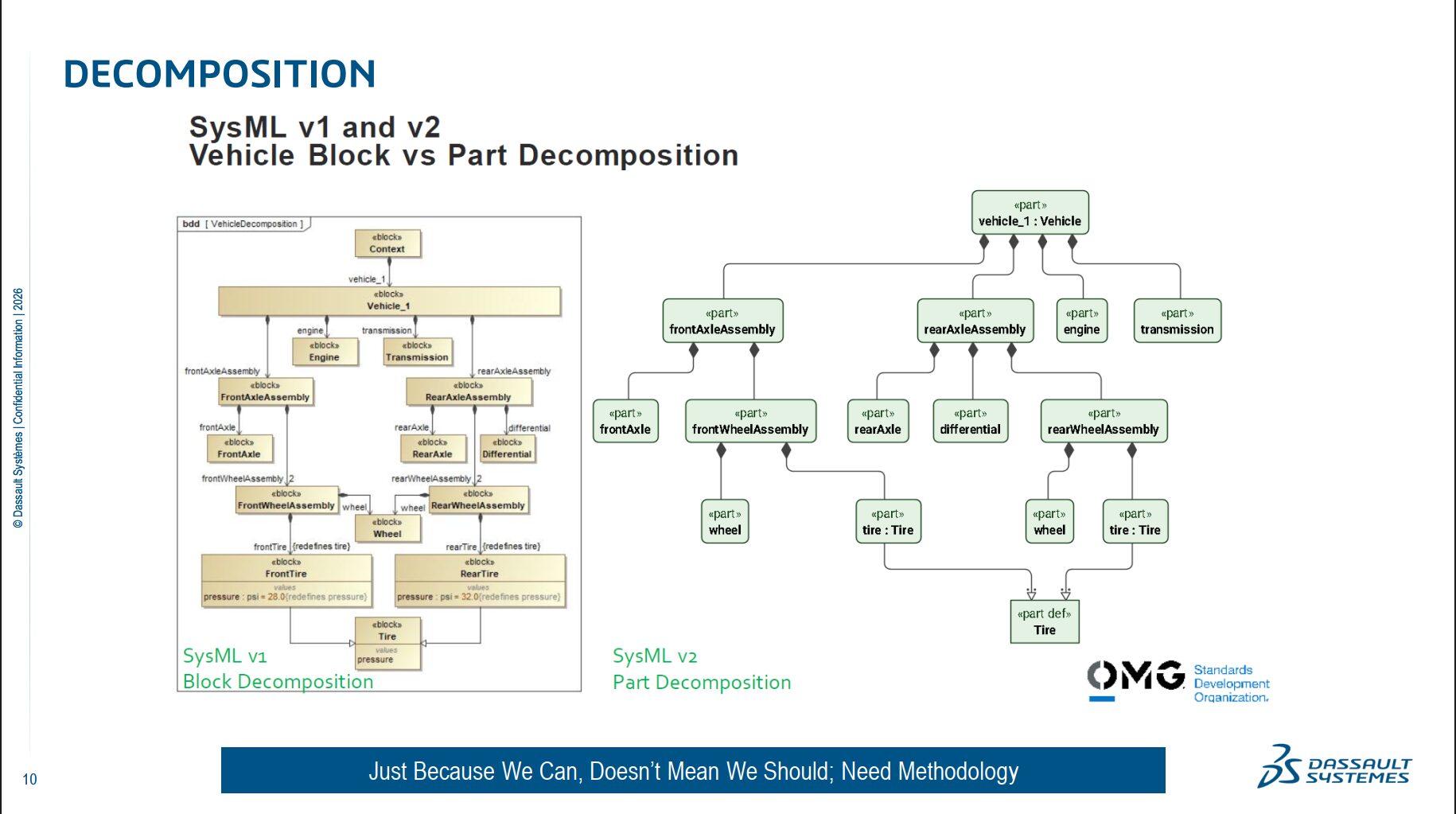
One session set the tone by arguing that SysML v2 is a new language, not a minor increment. The interesting part was the tension it explicitly called out:
- Increase semantic rigor (make models more precise and machine-meaningful)
- Simplify the user experience (make the tool feel more welcoming, not more academic)
This tension is not theoretical. In fact, teams are already finding that v2 provides multiple “correct” ways to model common things (use cases were explicitly mentioned). That means v2 adoption won’t just be training people on syntax—it will be about converging on patterns and conventions that are “correct enough” and repeatable.
Two things stood out as ecosystem-level enablers:
- Standardized APIs in the specification, meant to unlock plugins and extensions across tools.
- Model exchange that is improving (with ongoing work on diagram interchange).
The implicit message is simple: SysML v2 only becomes transformative once it is interoperable, automatable, and teachable.
2) Model organization SysML v2 shifts: flattening isn’t a style choice, it’s a performance strategy
A second thread focused on the day-to-day pain engineers feel: navigation, readability, and tool performance.
In SysML v1, model organization often converged on two familiar patterns:
- “Pillars/domains” (requirements, structure, behavior, parametrics)
- “Process” (stakeholder needs → requirements → architecture → V&V)
Both can work—until models get large, package trees get deep, and the human cost of finding things becomes significant.
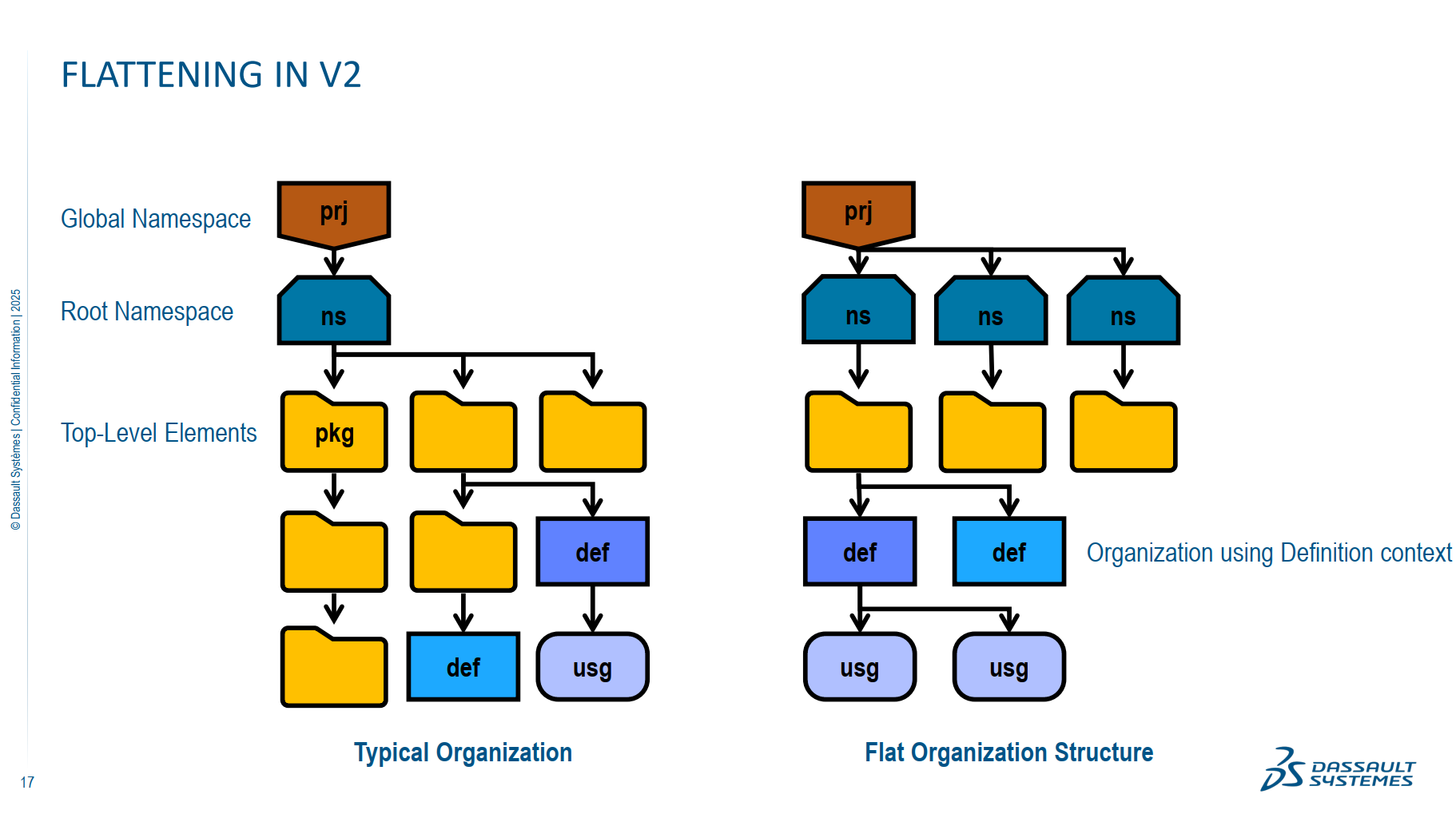
In SysML v2, the organizational primitives change. The talk emphasized:
- Projects + namespaces as a flexible modular structure.
- Usage-first modeling changes how teams express and reuse structure.
- Imports as a key readability tool (avoid long qualified names; “import what you use”).
The surprising takeaway was not “pick the perfect structure.” It was:
- Move toward flatter structures where possible.
- Use namespaces and imports to keep modularity without burying meaning in deep containment hierarchies.
There’s a practical reason this matters: text editors and tooling responsiveness degrade when too much context must be loaded, validated, and rendered at once. As a result, flattening becomes an enabling tactic for scale.
3) SysML v2 + AI in the tool: the workflow matters more than the model’s eloquence
Additionally, there’s a second-order implication: model organization is becoming an operational concern. Consequently, teams that don’t treat it as such will feel SysML v2 as “harder,” even if the semantics are better.
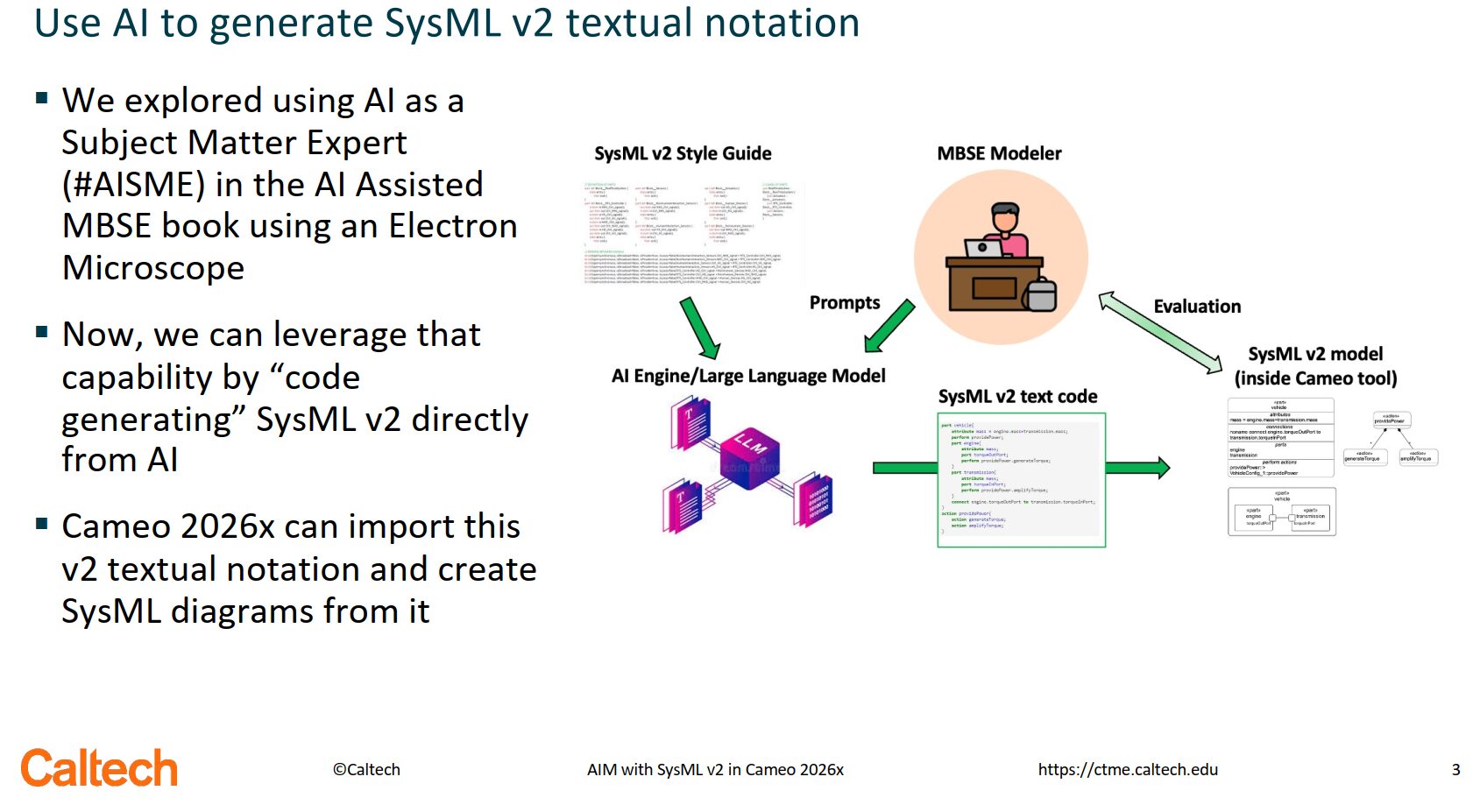
The AI-focused session described a product direction that is increasingly common across engineering software: a “virtual companion” that can teach, assist, and generate artifacts.
However, the most important content was not the marketing layer, but the workflow design choices:
3.1 AI-assisted modeling tools: predefined prompts and one-click actions
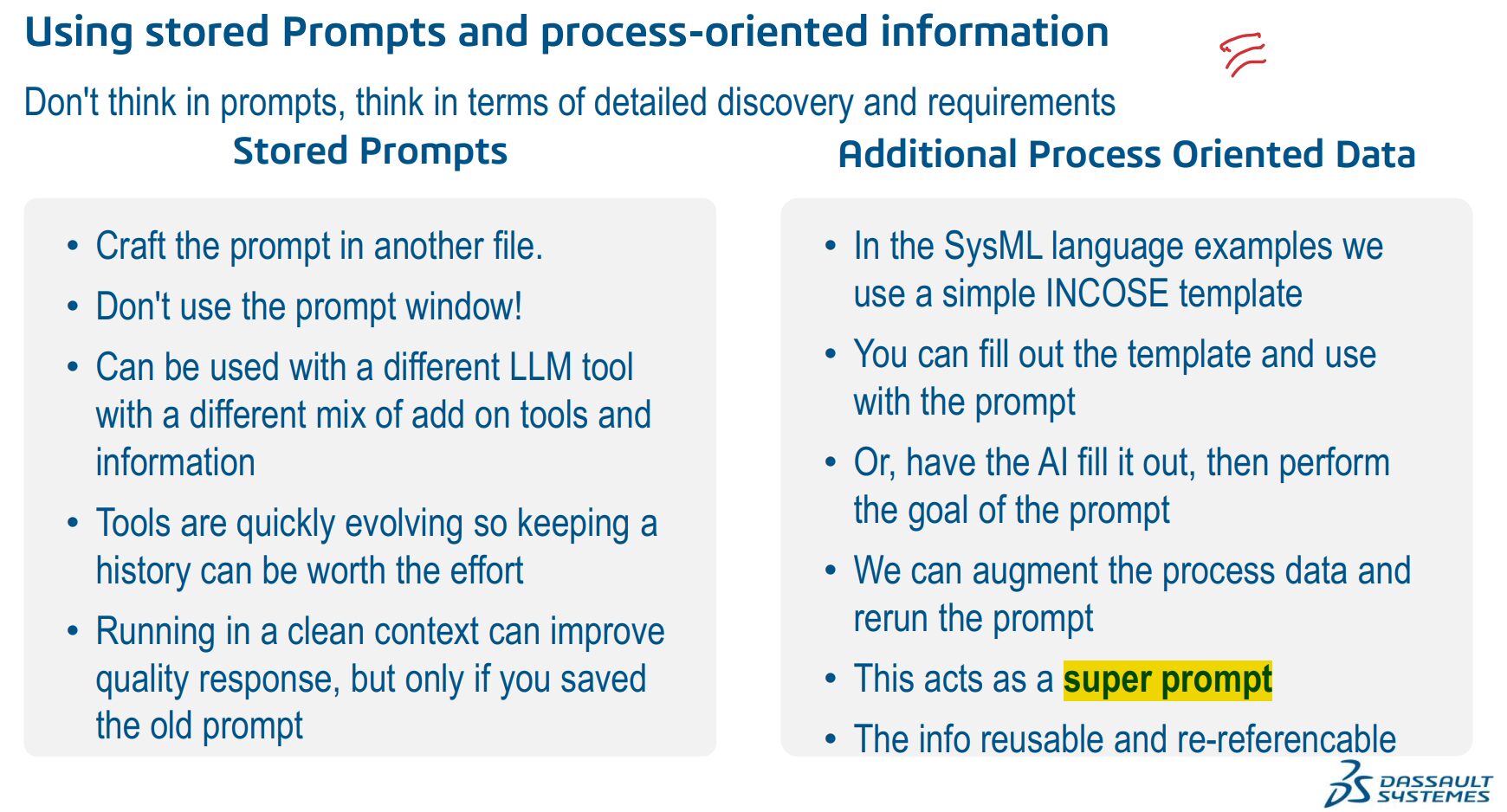
Before full chat-based experiences were mature, teams shipped predefined prompt tools tailored to object context (blocks, packages, requirements). For example, teams used these tools to keep assistance repeatable in specific contexts. The key advantage wasn’t intelligence—it was repeatability.
A notable pattern: teams used configuration files to define and tune these tools over time. That signals a shift toward treating AI assistance as a productized capability library, not one-off prompting.
3.2 SysML v2: PDF → requirements, but with traceability and review
Ingestion is where AI is immediately useful: extracting requirements from unstructured documents. But the session emphasized the risk: hallucinations or silent changes.
So they introduced a governance pattern that feels like “engineering CI/CD”:
- AI outputs land in a sandbox area.
- Humans review, delete, correct, iterate.
- Only then do they merge into the real model.
This is a crucial point: in systems engineering, review loops are the product. Without them, AI becomes a liability.
3.3 Demonstrations point toward orchestration, not substitution
The demos (requirements ingestion, block/parameter generation, trace links, mission behaviors, scenario tables) demonstrate the likely “sweet spot”:
- AI accelerates scaffolding and exploration.
- Engineers remain responsible for correctness and baselining.
The CUSA26 framing suggests a healthy posture: AI is valuable when it makes models more usable and faster to build—not when it tries to replace the engineering reasoning that models are meant to preserve.
4) SysML v2 federation with patches: the digital thread is organizational before it’s technical
If SysML v2 is meant to be a platform, federation is the reality that keeps it honest.
The federation session described the classic systems engineering dynamic:
- The system model specifies what is believed to be true.
- Subsystem teams refine design, discover realities, and return updates.
- The system model integrates those updates over time.
The “why” is straightforward:
- Systems are decomposed across hierarchy levels.
- Teams are distributed across disciplines, suppliers, and organizations.
- One monolithic model becomes a bottleneck and a risk.
4.1 Patches enable selective sharing and round-trip exchange
Patch technology was framed as a way to:
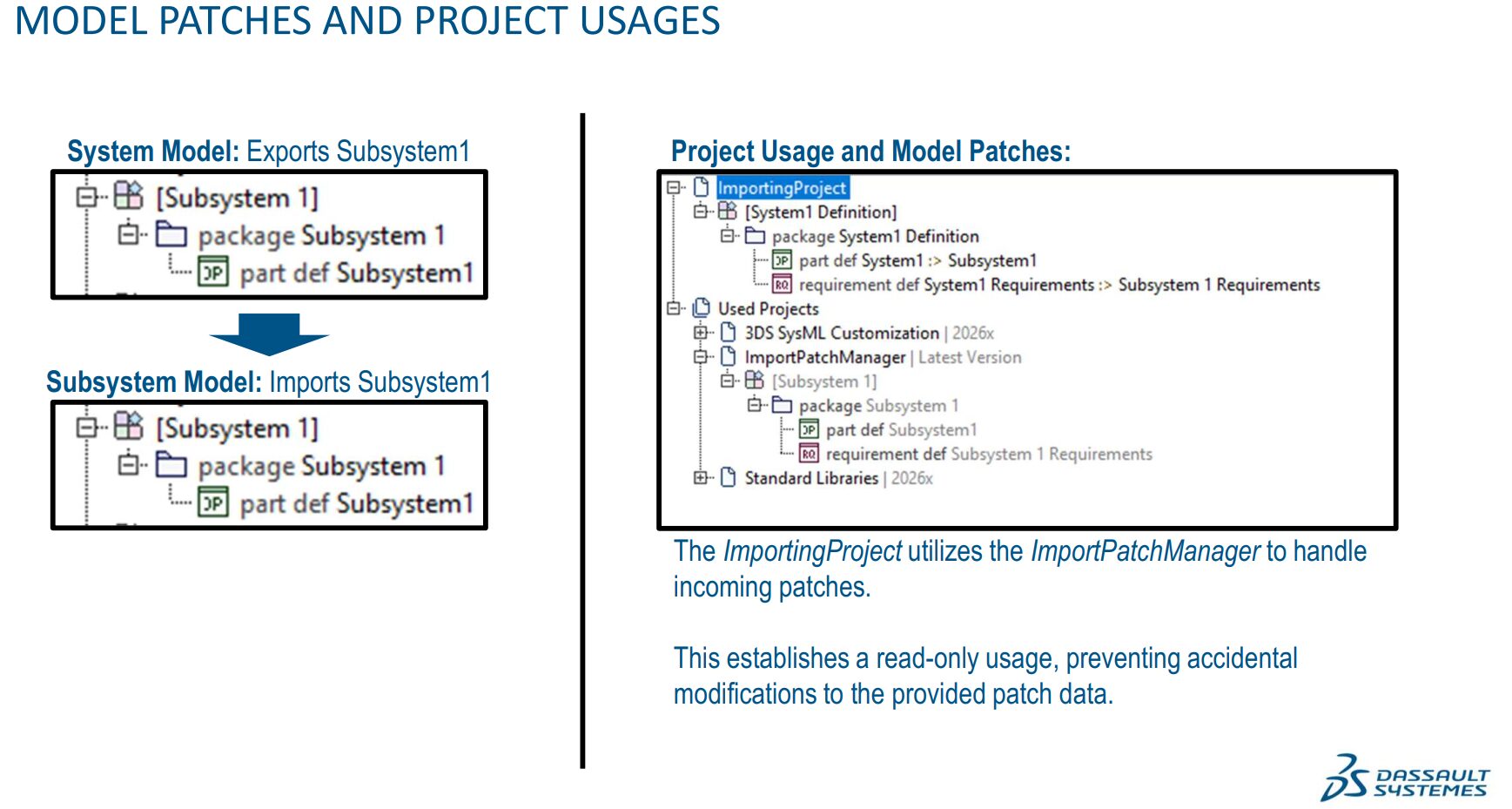
- export a scoped subset of a model
- import into another project/branch
- support round-trip exchange down to subsystems and back
A useful line from the session: patches let you send the book, not the whole library.
4.2 The core caveat: patch scope must be self-sufficient
The session emphasized a practical failure mode: if the patch depends on elements outside the patch (e.g., specializations or inherited definitions), that dependency can be lost.
This is where model organization and federation intersect:
- Deep, implicit dependencies make exchange brittle.
- Clear scoping and explicit libraries make exchange reliable.
4.3 A pattern worth adopting: landing zones for imports
One pragmatic pattern was to use a “subsystem import model” as a landing zone for patches and reference it read-only. This reduces accidental edits and gives teams a place to manage incoming changes.
The Q&A also surfaced the next maturity step many teams will want:
- patch repositories
- better history and “what changed” tracking
- better assurance that you’re using the latest patch
In short, federation is not just a feature—it’s a configuration management discipline.
5) Architecture generation: model the design space, don’t just document the chosen design
The “Architecture and Process” session proposed a shift that complements the rest of the CUSA26 themes.
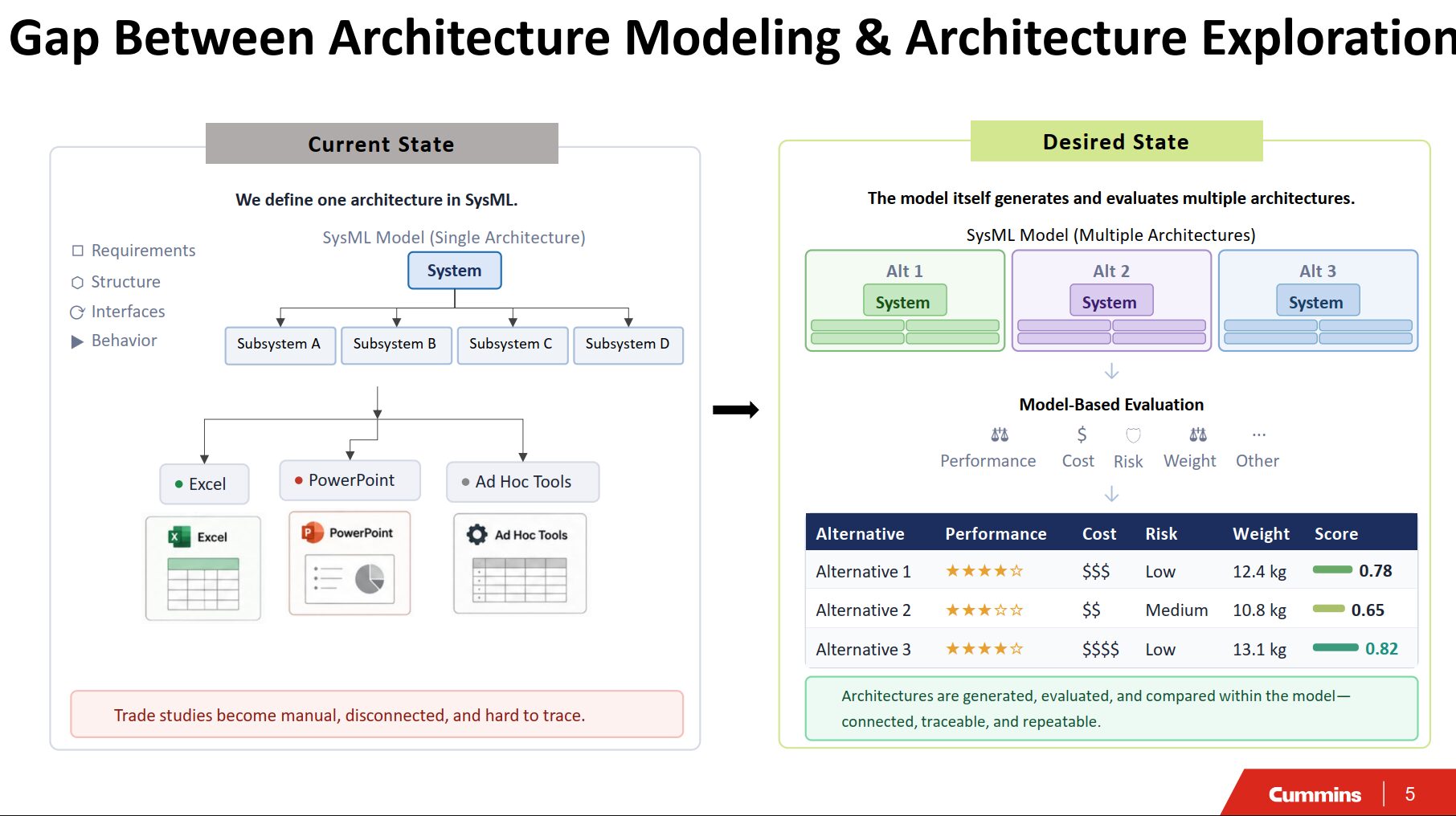
More importantly, traditional architecture workflows often flow one design from needs → requirements → functional → logical → physical. The talk argued that what’s missing is a systematic exploration step—and that today, exploration lives outside models (spreadsheets, scripts, tribal knowledge) and is lost when people rotate.
However, the proposed remedy is not “more diagrams.” It’s a change in what the model represents:
- Instead of one chosen architecture, model the family of possible architectures.
- Define variation points, variants, interfaces, and constraints.
- Use an external solver to generate valid candidate configurations.
This can be seen as bringing “computability” upstream:
- Human architects still set up the design space and the constraints.
- But the enumeration and pruning of combinations becomes machine work.
At the same time, the watch-outs were equally valuable:
- Generated architectures are only as good as the explicit assumptions and constraints.
- Requires/Excludes rules can become difficult to maintain at scale.
- Tool representations (like instance tables) may need new patterns to handle dynamic multiplicities.
As a result, this theme pairs naturally with the AI workflow story: once you have explicit rules, structured libraries, and repeatable patterns, automation can operate safely.
A capability stack: what CUSA26 implies you need to get right
Taken together, the sessions align as a single capability stack:
- Patterns and organization that keep models usable
- namespaces, imports, flatter hierarchies
- Federation and configuration control
- patches, scoping, landing zones, shared libraries
- Automation with governance
- sandbox/merge, repeatable tools, traceability
- Design-space thinking
- explicit variation points, constraints, solver-driven generation
- Interoperability as a baseline
- standardized APIs, exchange formats, (eventual) diagram interchange
This stack is why the “boring” things—naming, scoping, imports, libraries, patch discipline—keep showing up. They’re not overhead. They’re the prerequisites for scaling.
Practical takeaways (what to do next)
Decide and document your SysML v2 modeling patterns early.
- Treat this as an engineering standard, not personal preference.
Design your model organization for navigation and performance.
- Flatten where you can; use imports to keep text readable.
Adopt a “sandbox then merge” posture for AI-generated content.
- This should be a default safety rail.
Treat patches as configuration-managed deliverables.
- Define patch scopes explicitly, and keep them self-sufficient.
Start building a design-space vocabulary.
- Even if you’re not running solvers yet, naming variation points and constraints is future-proofing.
Closing
In short, CUSA26 didn’t present a single silver bullet. It presented a coherent view of what MBSE modernization actually requires: better semantics, yes—but also better organization, better governance, and better operational workflows.
The most useful way to interpret the sessions is this: SysML v2, AI assistance, and federation are not separate trends. They’re parts of the same transition toward models that can be shared, automated, and evolved over time—without collapsing under their own complexity.